THE PRoblem
Financial wellbeing affects more than money
Money pressures are a major cause of stress and anxiety
Financial stress impacts performance, productivity and retention
Many employees lack confidence in essential money skills
Without early support, money challenges can quickly escalate
It can be hard for employers to measure financial wellbeing, quantify risk or demonstrate impact and ROI
THE solution
Measure it. Understand it. Improve it.
FinWELL Money Score® helps turn financial wellbeing into something employees and employers can actually measure and improve.
10 simple research-based questions
Takes around 2 minutes
Instant personal FinWELL Money Score
Identifies key areas for improvement
Provides personalised next steps
Completely confidential for employees
Generates data insights for employers
for employers
Free for a limited time only
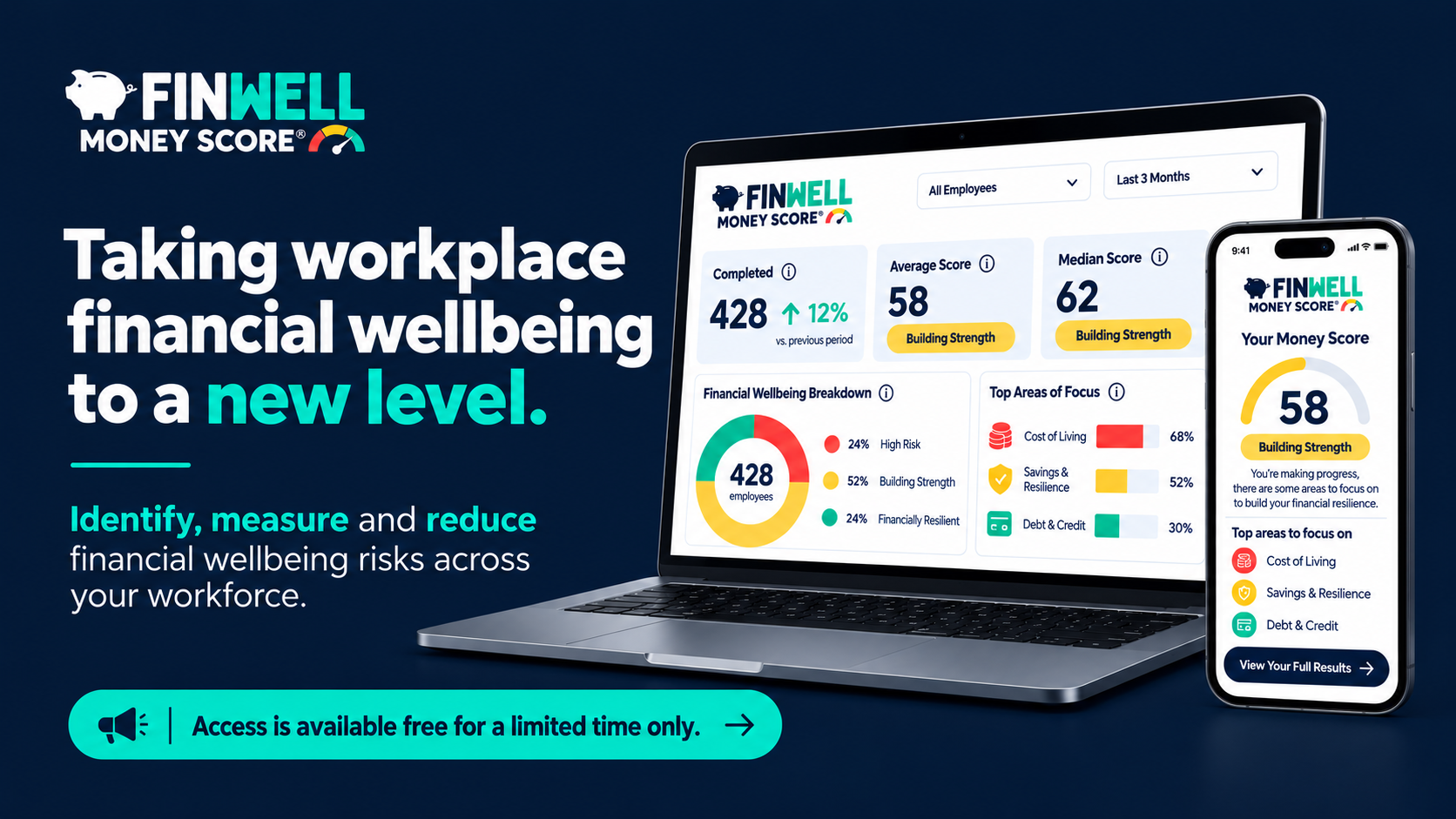
Measure financial wellbeing across your workforce
Simple dashboard view
Identify higher-risk groups and emerging trends
Understand the biggest areas of financial concern
Compare teams, locations and employee groups
Consider data-driven, pro-active, preventative and inclusive interventions
Track progress over time
Maximise engagement and impact
Use real-time insights to target support and ensure return on investment
Identify → Measure → Improve
FINANCIAL WELLBEING, HEALTH & SAFETY AND PSYCHOSOCIAL RISK responsibilities
Financial Wellbeing doesn’t sit in isolation.
The FinWELL Money Score helps employers identify, measure and better understand financial wellbeing risks across their workforce.
This providing anonymous insights to inform targeted support and measure improvement over time.
It can complement wider approaches to work-related stress, psychosocial risk, employee wellbeing and health & safety, including guidance and frameworks from the HSE, ISO 45003, Construction Leadership Council Mental Health Joint Code of Practice and Investors in People.
-
We’re rolling the FinWELL Money Score and Employer Dashboard with our existing clients including trials with the likes of University of Birmingham, Devon, Cornwall & Dorset Police and large employers in the construction and infrastructure sector.
-
We’re currently rolling it out with existing clients in beta mode and also making it free to access for selected employers as part of an initial pilot phase.
Pilot places are limited while we gather feedback, engagement data and employer insights ahead of the wider launch.
-
The FinWELL Money Score provides employers with anonymous workforce-level insights into financial wellbeing, helping identify potential areas of risk, groups requiring greater support and opportunities for early intervention.
It can complement an employer’s wider approach to health & safety, work-related stress and psychosocial risk management by helping turn employee insight into measurable action.
-
Employers have a legal duty to protect workers from work-related stress by assessing risks and taking appropriate action.
Financial wellbeing is not, by itself, a separate statutory HSE risk assessment requirement. However, financial pressures can interact with workplace factors and contribute to stress, wellbeing and people’s ability to function effectively at work.
The FinWELL Money Score can therefore provide useful additional insight alongside an employer’s existing stress and health & safety risk-management processes.
-
The HSE Management Standards identify six key areas associated with work-related stress:
Demands • Control • Support • Relationships • Role • Change
Financial pressures can interact with several of these areas — for example, organisational change, job insecurity, working hours, pay, access to support or changes to benefits.
FinWELL helps employers better understand financial wellbeing across their workforce and provide appropriate preventative education and support.
-
ISO 45003 provides guidance on managing psychological health and safety and psychosocial risks at work.
The FinWELL Money Score can complement this approach by providing anonymous financial wellbeing insights, helping employers identify areas requiring attention, introduce appropriate interventions and monitor changes over time.
It should be viewed as part of a wider psychosocial risk-management approach rather than a replacement for an organisation’s occupational health and safety processes.
-
The CLC Mental Health Joint Code of Practice specifically recognises Financial Issues as one of its workplace hazard clusters.
The FinWELL JCOP summary identifies examples including financial uncertainty, cashflow pressures, late or disputed payments, job insecurity, commercial pressures and low financial literacy.
The Code promotes a preventative approach:
Identify → Assess → Control → Monitor → Improve
This aligns particularly well with the FinWELL approach to measuring financial wellbeing, identifying priority areas, providing targeted support and monitoring improvement.
The summary also specifically identifies anonymous assessments and employee feedback as practical measures employers can consider.
-
The FinWELL Money Score can help with the identification and measurement of financial wellbeing risks, while wider FinWELL services can help organisations take practical preventative action.
This can include Money Skills training, leadership and manager training, Financial Wellbeing Champions, apprentice and early-careers programmes, confidential 1-1 guidance, digital learning and signposting to specialist support.
-
Yes. The Money Score can provide employers with additional evidence of how they are listening to employees, identifying wellbeing needs, taking targeted action and measuring improvement.
This can complement an organisation’s broader people and wellbeing strategy and potentially provide useful evidence when working towards frameworks such as Investors in People / We Invest in Wellbeing.
-
No.
The FinWELL Money Score is designed to complement, not replace, an employer’s statutory health & safety, work-related stress or psychosocial risk-assessment processes.
It provides an additional layer of insight specifically around financial wellbeing, helping employers understand their workforce and make more informed decisions about preventative support.
-
Employees receive their own FinWELL Money Score and personalised next steps, while employers receive anonymous, aggregated workforce insights.
The purpose is to identify trends and areas for improvement across the workforce, not to disclose an individual’s personal financial circumstances to their employer.
-
Measurement should be the starting point, not the end point.
FinWELL can help employers move through a simple continuous-improvement process:
IDENTIFY financial wellbeing risks
→ MEASURE workforce needs
→ UNDERSTAND priority areas
→ ACT with targeted education and support
→ MONITOR progress
→ IMPROVE and re-measureThis closely reflects the preventative risk-management approach highlighted within the CLC Code, which encourages organisations to assess risk, introduce appropriate controls and support, monitor effectiveness and continually improve.